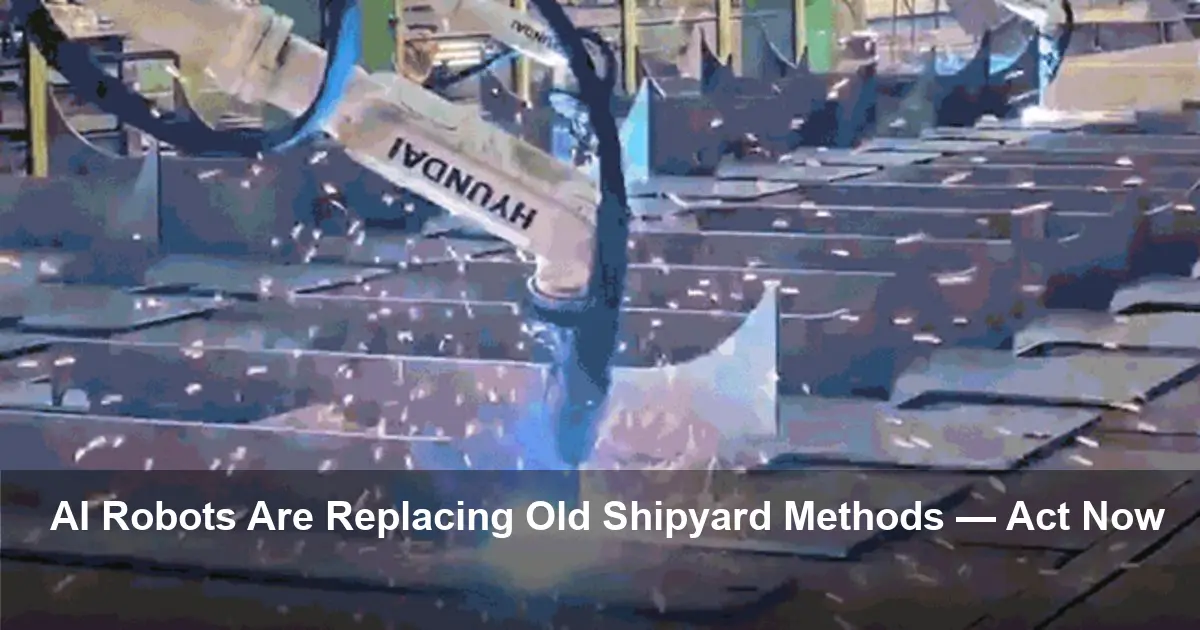
- HD Hyundai has deployed AI-powered robots in its shipyards to autonomously handle cutting, alignment and welding.
- The new systems, introduced in December, are reported to raise productivity and reduce costs while improving safety and precision.
- The move signals faster automation across heavy manufacturing and raises questions about workforce change, quality control and competitive pressure.
HD Hyundai Rolls Out Autonomous Robots in Shipbuilding
What changed
HD Hyundai has introduced AI-driven robotic systems to perform core shipbuilding tasks — cutting, alignment and welding — with minimal human intervention. The company says the machines operate autonomously on repetitive, precision-dependent steps of the production line, allowing human workers to focus on supervision, complex assembly and quality assurance.
Why it matters
Automation in shipyards tackles three enduring industry headaches: long lead times, high labor intensity and variability in weld quality. By applying machine vision, path-planning algorithms and automated welding heads, HD Hyundai aims to lift throughput and reduce rework. Executives and industry observers view the rollout as proof that heavy-manufacturing sectors can adopt advanced AI robotics at scale.
Productivity, cost and safety impacts
Early internal reports indicate improvements in cycle time and lower material waste due to more consistent cuts and alignments. The automation of hazardous tasks such as welding also reduces direct worker exposure to fumes, heat and repetitive strain. HD Hyundai frames the initiative as both a cost- and safety-driven modernization effort.
Workforce and industry implications
Wider adoption of AI robotics in shipbuilding will reshape skills demand: fewer workers may be needed for repetitive welding, while demand grows for technicians, robot programmers and quality engineers. That raises questions about retraining, social responsibility and how quickly other shipbuilders will follow to remain competitive.
Broader context and next steps
HD Hyundai’s move reflects a broader industrial trend toward integrating AI, robotics and digital twins to speed production and reduce errors. For rival shipyards and suppliers, the message is clear: automation can deliver measurable operational gains, and those who delay risk falling behind on cost and delivery metrics.
What to watch
- Announcements from other shipbuilders about similar deployments or partnerships with robotics firms.
- Details on performance metrics from HD Hyundai, such as percentage gains in productivity or reductions in defect rates.
- Labor and policy responses addressing workforce transition and site safety standards.
No embedded social media or video links were included in the source briefing. If official video demonstrations or social posts are released by HD Hyundai, they should be embedded alongside future coverage to validate performance claims and show the robots in operation.
Reporting note: This article summarizes the core developments around HD Hyundai’s deployment of AI robotic systems for shipbuilding tasks based on the announced rollout in December and industry analysis of likely impacts.
Image Referance: https://www.chosun.com/english/industry-en/2026/01/01/ZX2QNJP6JND5TJ2DQYYS22S7CE/