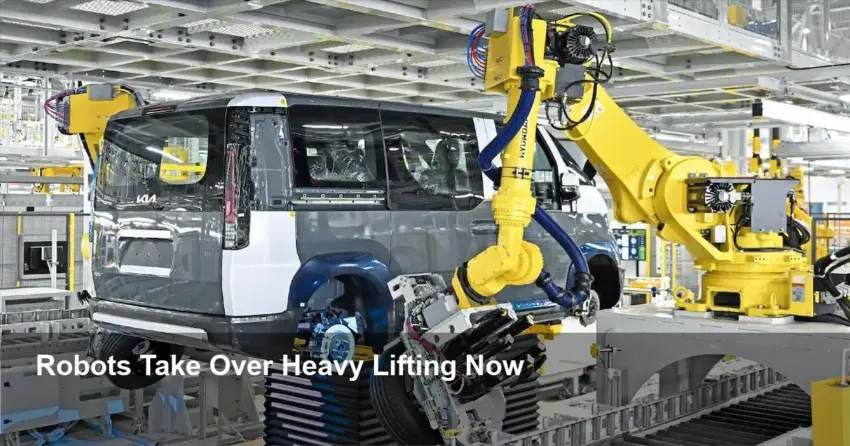
- Kia’s AI robots at EVO Plant East install a 50kg tailgate in 105 seconds.
- The AI-driven line aims to improve precision and reduce strenuous manual tasks.
- The move may lower injury risk and speed assembly, but raises questions about workforce change.
What happened
Kia has deployed AI-controlled robots on an assembly line at its EVO Plant East that can mount a 50kg tailgate in 105 seconds. The announcement highlights the use of artificial intelligence to guide robotics for a task that traditionally required significant human strength and coordination.
Why this matters
The short cycle time and the weight involved make this a high-impact automation task. Fitting a heavy tailgate precisely requires both force and accuracy; using AI-driven robots helps keep alignment consistent while reducing the physical burden on line workers. That combination can reduce the risk of workplace injuries and rework caused by misalignment.
Production and quality
Even without additional published metrics, a stable 105-second cycle for a single fitment indicates potential for steady throughput improvements on the line. Consistent, repeatable robotic actions driven by AI decision-making can reduce variability between shifts and operators, helping maintain build quality.
Worker safety and ergonomics
Handling a 50kg component repeatedly is strenuous. Automating this step removes one of the more physically demanding tasks from human workers, which could lower fatigue-related errors and short-term injury risk. At the same time, such changes typically shift human roles toward monitoring, quality checks, and maintenance.
Broader implications
Kia’s deployment is a case study in how AI and robotics are being applied to the most physically demanding assembly operations. For manufacturers, the benefits are clear: improved consistency, safer workplaces, and potentially faster cycle times. For workers and plant managers, it means retraining and new maintenance demands.
Workforce considerations
Automation that reduces strenuous tasks often prompts concerns about job displacement. In practice, many factories that add robots also create needs for technicians, programmers, and supervisors who can operate and maintain the automated systems. The balance between fewer manual tasks and new technical roles will depend on how widely and quickly the technology is rolled out.
What’s next
Kia’s approach at EVO Plant East will likely be watched by other automakers and suppliers. If the system delivers consistently — and if integration and maintenance costs are manageable — similar AI-driven fitment cells could be adopted for other heavy components. Observers will be looking for follow-up data on throughput, uptime, and any measurable safety improvements.
Bottom line
Kia’s AI robots installing a 50kg tailgate in 105 seconds is a concrete example of how automation can remove strenuous work while boosting precision. The move illustrates both the potential upside for quality and safety and the real need to manage workforce transitions as factories modernize.
Image Referance: https://www.chosun.com/english/industry-en/2026/02/02/6QZ7PJWIVNBL5O5KA3RIXCGDCM/