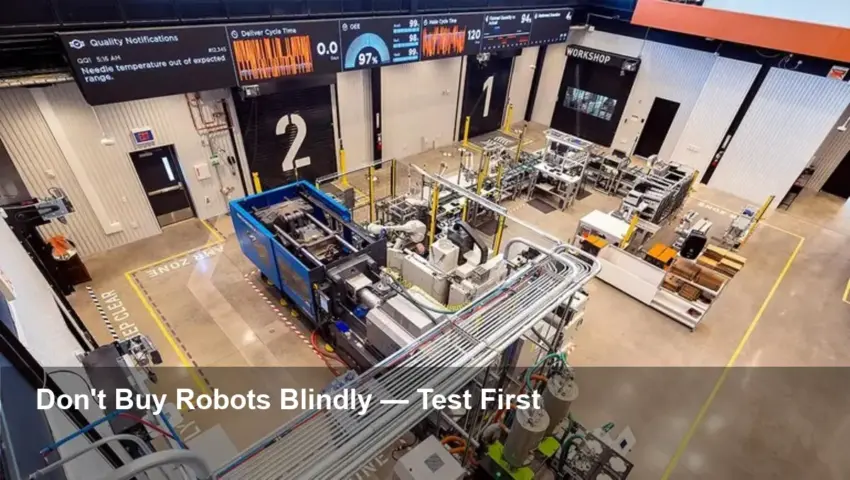
- Manufacturers are increasingly using physical testing centers to trial robotics and AI before committing large investments.
- Deloitte, Tata Consultancy Services and Microsoft are among the companies offering labs and pilot programs to de‑risk automation projects.
- These centers let operations teams validate integration, performance and ROI in real factory-like environments.
Why manufacturers are turning to physical AI testing centers
Demand for automation has surged, but so have the risks of expensive rollouts that fail to deliver. Testing centers — physical labs and pilot environments run by consulting firms, system integrators and tech vendors — let manufacturers try robotics and other physical AI systems on a smaller scale. Deloitte, Tata Consultancy Services and Microsoft are among the organizations providing access or services that let companies experiment without committing to full deployment.
What these centers do
Testing centers typically recreate parts of a production line or set up modular cells where robots, sensors and AI software can be combined and evaluated. Manufacturers can see how systems perform under realistic conditions, test integration with IT and OT systems, measure cycle times and assess how the new equipment will interact with existing processes and teams.
These pilots help answer the practical questions that matter to decision makers: Will the technology actually improve throughput? What are the hidden integration costs? How much training will the workforce need? Rather than relying on sales demos or vendor claims, teams can run data-driven trials and compare alternatives.
Why this matters now
The move toward physical testing is driven by multiple pressures: tight capital budgets, a persistent skills gap in industrial AI and the need to show clear ROI before large purchases. Testing centers reduce uncertainty, letting companies identify failure modes early and avoid costly mistakes. They also give operations and engineering teams hands-on experience, speeding up adoption when pilots succeed.
Vendors benefit too. Labs provide real-world feedback that can refine hardware, software and service offers, and they create a lower-friction path for customers to move from proof-of-concept to deployment.
What manufacturers should look for
When evaluating a testing center or pilot program, companies should confirm that the lab can simulate their production conditions, provide measurable KPIs, and offer a clear roadmap from pilot to scale. Access to integration expertise — especially for connecting AI systems to existing control systems — is critical. Manufacturers should also ask about training and change-management support so that successful pilots transfer into sustained operations.
Bottom line
As automation investments grow, physical AI testing centers are becoming a practical tool to reduce risk and accelerate adoption. By letting manufacturers validate performance, integration and workforce impact before spending heavily, these labs are shifting how industrial AI projects are planned and budgeted — and they are increasingly offered by major consultancies and tech companies as a way to build trust and prove value.
Image Referance: https://www.manufacturingdive.com/news/manufacturing-ai-automation-robotics-testing-deloitte-tata/817036/