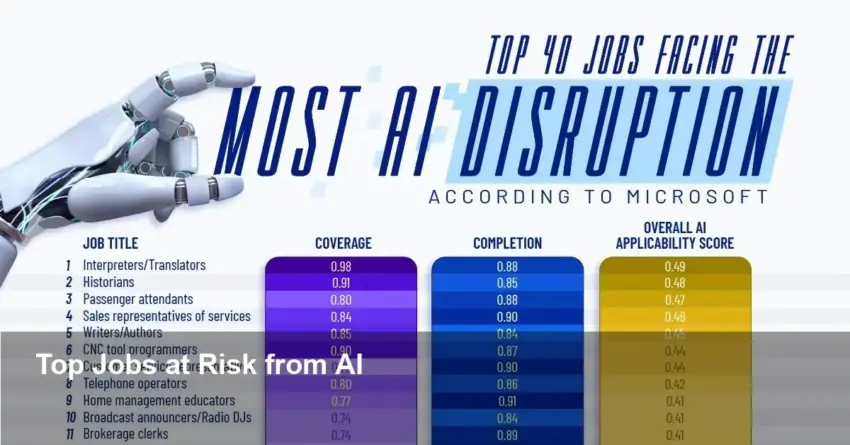
- Microsoft analysis shows creative and communication roles are among the most exposed to generative AI.
- Many technical jobs also display moderate-to-high AI applicability, meaning task changes across industries.
- Exposure highlights task-level disruption more than immediate job losses — reskilling and adaptation matter.
- Employers and workers should prioritize human strengths—strategy, judgment, and specialized technical oversight.
What Microsoft’s analysis found
Microsoft’s recent ranking identifies creative and communication-based occupations as the most exposed to generative AI, with a range of technical roles showing moderate-to-high applicability as well. The core finding: AI tools are most capable of automating or assisting tasks that rely on pattern generation, language, and replication of routine creative output.
This doesn’t mean wholesale job elimination overnight. Instead, the report points to which tasks inside roles are most likely to change — drafting, routine content production, and template-based design work — and which tasks remain anchored to human judgment, relationship-building, and strategic decision-making.
Which types of jobs are most exposed
-
Creative and communication roles: Jobs that involve writing, generating visual concepts, or producing standard marketing and PR materials are flagged as highly exposed. Examples include copywriting, content creation, basic design and some social media production.
-
Technical roles with moderate-to-high applicability: Certain technical tasks — such as code generation, data summarization, and documentation — are increasingly supported by generative models. This means software teams, analysts, and technical writers may see parts of their workflows augmented.
-
Task-level nuance: Exposure varies within occupations. Senior specialists who oversee complex systems or provide bespoke creative direction are less exposed than entry-level roles focused on repetitive content generation.
Why this matters now
The ranking underlines a shift from thinking about whole jobs being “replaced” to understanding which tasks will be automated or augmented. For businesses, this means immediate opportunities to boost productivity by integrating AI into content creation and developer tooling — but also the risk of unmanaged disruption if workforce planning doesn’t keep pace.
For workers, the message is clarity: skills that emphasize creativity, critical thinking, domain expertise, interpersonal negotiation and contextual judgment are harder to automate. Roles that rely heavily on repeatable generation tasks are where change is most likely to appear first.
How companies and employees should respond
-
Employers: Map tasks within roles, invest in retraining, and redesign jobs so human strengths complement AI capabilities. Establish clear guardrails for quality and ethics when deploying generative models.
-
Workers: Upskill into oversight, strategy, and complex problem solving. Learn to use generative AI as a productivity tool rather than seeing it only as a threat.
Microsoft’s ranking is a wake-up call — not a prediction of mass layoffs — but a practical guide to where businesses and workers should focus adaptation efforts as generative AI spreads across industries.
Image Referance: https://www.visualcapitalist.com/ranked-the-jobs-most-exposed-to-generative-ai-according-to-microsoft/