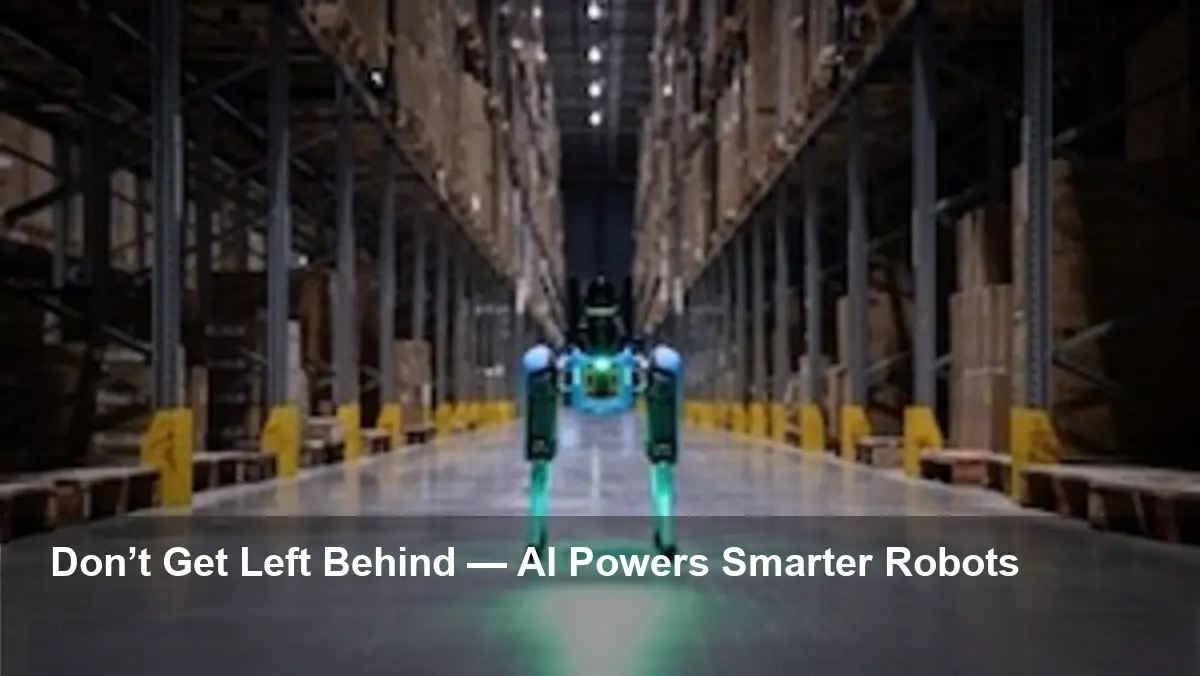
- Otto Group has integrated NVIDIA AI to improve multi-robot coordination and reduce operational bottlenecks.
- The solution focuses on real-time perception, centralized orchestration and simulation-informed training to improve throughput and reliability.
- Manufacturers may face competitive pressure to adopt similar AI-driven orchestration or risk falling behind.
Otto Group applies NVIDIA AI to upgrade robotic coordination
Otto Group has announced a major step toward smarter automation by applying NVIDIA artificial intelligence to coordinate fleets of robots across its logistics and warehousing operations. The move aims to reduce collisions, idle time and manual intervention by giving robots better situational awareness and a central brain for task scheduling.
What the integration delivers
Rather than replacing hardware, Otto Group’s approach layers AI-driven perception and decision-making on top of existing robotic systems. Key elements include:
Real-time perception
AI models running on NVIDIA GPUs process camera and sensor feeds to create a live, unified view of movement on the warehouse floor. This helps robots detect dynamic obstacles and predict short-term motion of other agents.
Centralized orchestration
A coordination layer assigns tasks and sequences movements so multiple robots can execute interdependent actions without conflict. By planning collectively rather than independently, the system reduces deadlock and repetitive route corrections.
Simulation and continuous learning
Simulation tools allow engineers to train and validate policies in virtual replicas of production environments before pushing updates to live systems. This simulation-informed feedback loop accelerates deployment while lowering risk.
Why this matters for operations
For large-scale fulfillment and logistics operators, the combination of perception, orchestration and simulation can translate into fewer stoppages, lower manual oversight and smoother peak-period performance. Otto Group’s adoption signals a shift from point automation to coordinated, adaptive systems.
Competitive pressure and FOMO
As more companies publish success stories around AI-driven coordination, organizations that delay adopting similar capabilities may face higher labor costs, lower throughput and slower response to demand surges. Industry observers say early adopters can achieve operational resilience that becomes a competitive baseline.
Industry implications and next steps
Implementing coordinated AI is not plug-and-play: it requires investments in compute, data pipelines, simulation and safety validation. Otto Group’s rollout will likely be iterative, starting with contained zones and expanding as models prove reliable. Partners and suppliers in robotics, sensors and software stand to benefit from increased demand for integrated solutions.
While specific performance metrics from Otto Group have not been widely published, the strategic use of NVIDIA AI highlights a broader trend: manufacturers are moving toward smarter orchestration to unlock efficiencies previously limited by siloed robotic systems.
There were no explicit social media embeds or videos shared alongside the announcement in available summaries.
Watch this space: coordinated AI for robotics is shifting from research demos into practical deployments, and companies that adapt quickly are positioned to capture the operational and commercial advantages.
Image Referance: https://www.textileworld.com/textile-world/2026/01/next-level-intelligent-automation-otto-group-enhances-robotic-coordination-with-nvidia-ai/