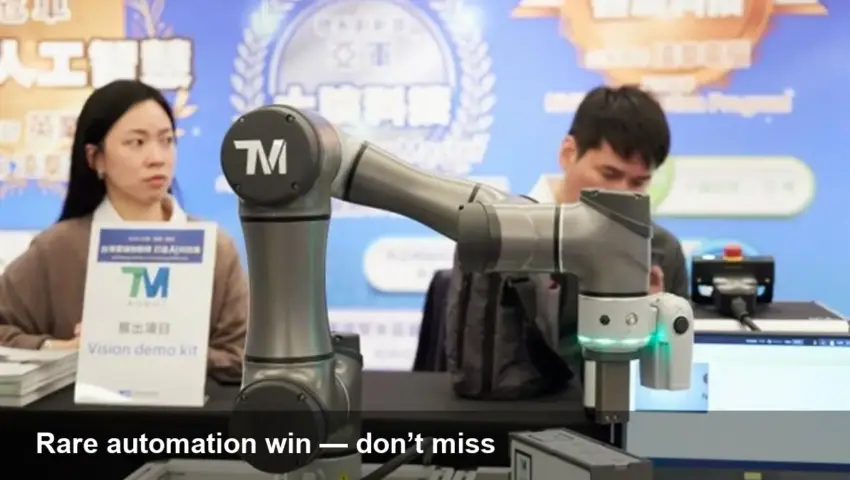
- Techman Robot, a global leader in collaborative robotics, supported Jinpao Precision (JPP) in a large-scale automation overhaul.
- JPP, a precision metal components maker, achieved automation in an industry typically defined by low volumes and high variability.
- The project highlights cobots’ ability to bring flexibility, consistency and safety to complex aerospace production.
What happened
Jinpao Precision (JPP), a high-tech manufacturer of precision metal components, completed a large-scale automation overhaul with help from Techman Robot, a global leader in collaborative robotics. The move is notable because aerospace production is often characterized by low volumes, frequent product variability and strict quality requirements—conditions that historically make wide automation difficult.
Why this is unusual
Aerospace suppliers typically rely on skilled manual labor and small-batch processes. That model persists because frequent engineering changes, tight tolerances and certification demands leave little room for fixed, high-volume automation lines. According to the short description of the project, JPP’s overhaul stands out precisely because it breaks that pattern: the company integrated collaborative robots (cobots) to automate tasks across the factory floor at a scale rarely seen in the sector.
What cobots bring to the factory floor
Collaborative robots are designed to work alongside people and to be more flexible than traditional industrial robots. For manufacturers facing variable part runs and precision requirements, cobots can:
- Reduce repetitive strain and free skilled workers for higher-value tasks.
- Provide consistent cycle times and repeatable quality for precision parts.
- Be reprogrammed or redeployed more quickly than fixed automation, matching the variable nature of aerospace work.
These advantages help explain why JPP’s rollout with Techman Robot is being highlighted: it demonstrates that with the right robotic platform and integration approach, even industries with low-volume, high-variation production can realize meaningful automation gains.
Why it matters for other manufacturers
The JPP–Techman Robot example functions as a proof point. If other precision manufacturers and aerospace suppliers can replicate this balance of flexibility and control, the industry could start shifting away from purely manual, labor-intensive models. That would have consequences for cost control, throughput, and the allocation of skilled labor.
Limitations and next steps
The short description does not provide technical specifics, adoption timelines or measurable performance outcomes. Those details—cycle-time improvements, defect-rate reductions, certification impacts and workforce transitions—will determine how widely the approach can scale. Still, the project signals a clear trend: collaborative robotics are becoming capable enough to tackle tasks once deemed too variable or delicate for automation.
Bottom line
JPP’s large-scale automation overhaul with Techman Robot is a rare and instructive case in aerospace manufacturing. It shows that cobots can be a practical tool for precision manufacturers seeking flexibility without sacrificing quality—and that companies who ignore this shift may be at risk of falling behind as automation becomes more adaptable.
Image Referance: https://www.digitimes.com/news/a20260128PD234/techman-automation-robotics-production-manufacturing.html