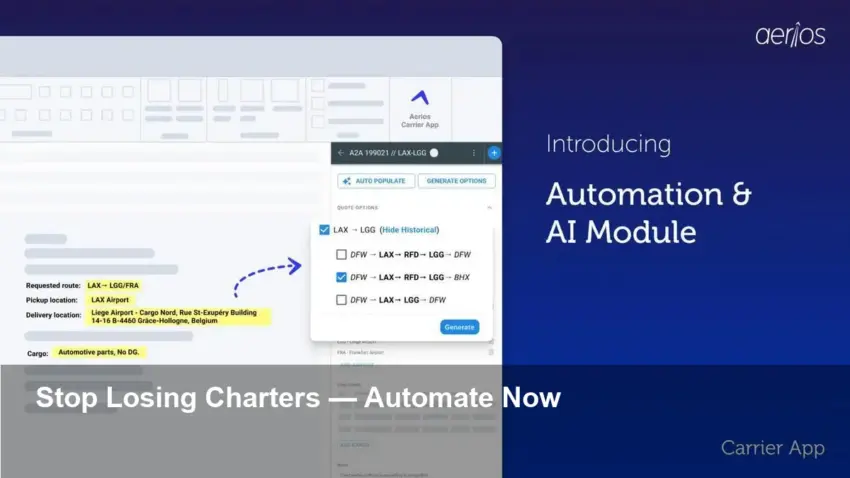
- Aerios has launched an AI-driven automation module for air cargo charter quotes.
- The module promises to dramatically shorten quoting time, improving speed and responsiveness.
- GetTransport.com covered the launch and highlights potential operational gains and risks for carriers and brokers.
- Adoption will hinge on integration, data quality, and maintaining human oversight to avoid costly mistakes.
What Aerios announced
Aerios has introduced an AI-powered automation module designed to speed up air charter quoting. According to coverage on GetTransport.com, the tool automates parts of the quote process that have traditionally required manual input and back-and-forth checks, with the stated effect of substantially reducing the time it takes to produce a charter offer.
Why this matters to carriers and brokers
Faster, more consistent quotes can change the dynamics of air cargo sales. In a market where speed matters, being able to answer customer requests sooner increases the chance of winning business. For brokers juggling multiple requests, automated quoting can free staff from repetitive tasks, letting them focus on exceptions and customer relationships.
But there are clear risks, too. Automation that prioritizes speed over accuracy can produce mispriced or infeasible quotes that, if accepted, create operational headaches and reputational damage. That puts pressure on firms to keep human checks in place and to validate AI outputs against real-world constraints such as aircraft availability, crew schedules, and regulatory limits.
Practical implications and integration
Integrating an AI module into existing workflows requires clean data and well-defined business rules. Companies considering Aerios’ module will need to verify that their booking systems and freight-management platforms can feed reliable tariffs, routing rules, and aircraft constraints into the AI. Without good input data, any automation—even highly capable AI—can underperform or produce risky results.
Early adopters are likely to focus first on high-volume, low-complexity routes where the AI can demonstrate time savings with lower operational risk. More complex charters—special cargo, multi-stop flights, or regulated shipments—will probably keep human oversight for the foreseeable future.
Operational and workforce effects
Automation often shifts work rather than eliminates it. Staff who previously prepared quotes may move into roles that handle exceptions, verify AI recommendations, and manage customers. Teams must be trained to interpret AI-driven outputs and to correct model errors quickly.
What to watch next
- Adoption speed: watch which carriers and brokers announce trials or rollouts on their networks.
- Accuracy and exceptions: monitor reports about misquotes or operational disruptions tied to automated proposals.
- Integration partners: see whether Aerios publishes connectors for popular TMS platforms or details on data requirements.
GetTransport.com’s report flags the launch as a meaningful development for air-freight logistics. For carriers and brokers, the choice is clear: evaluate the new AI tools quickly and design safeguards, or risk losing responsiveness to rivals who move faster. The safest path combines AI efficiency with human oversight to capture speed gains without exposing operations to preventable errors.
Image Referance: https://blog.gettransport.com/news/ai-powered-automation-module-air-cargo/