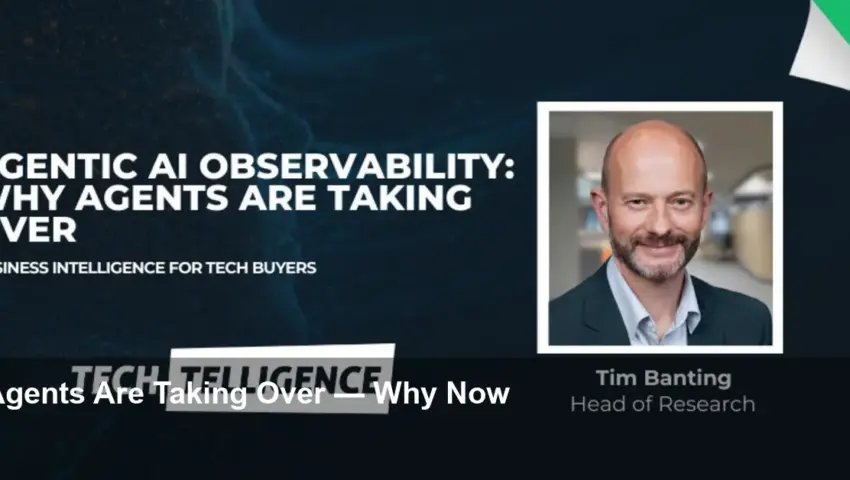
- Analyst Tim Banting says agentic systems aim to complete workflows, not just assist users.
- Copilots often stall inside workflows; agents act autonomously and coordinate multiple tools.
- Observability — tracing, logs, and guardrails — becomes critical to control, trust, and compliance.
- Companies must adopt monitoring, human‑in‑the‑loop checks and governance before scaling agentic AI.
What’s happening: agents vs. copilots
Analyst Tim Banting draws a clear line: while copilots typically assist a user inside a workflow, agentic systems are designed to complete the workflow on behalf of the user. That shift — from assistance to autonomous execution — is why many organisations are now piloting or deploying agentic AI rather than relying solely on copilots.
Why copilots are stalling
Limited autonomy
Copilots are built to support humans inside defined tasks. They surface suggestions, automate small steps, or make complex tools easier to use, but they still depend on user direction. In multi‑step workflows that require coordination across systems, that dependency can slow progress and increase friction.
Handoffs and complexity
When a task needs orchestration—calling APIs, fetching data, confirming business rules—copilots often require frequent handoffs back to users. Those handoffs create delays, errors and lower adoption in frontline teams that expect complete outcomes.
Why agentic systems are gaining ground
Agentic AI is built to take ownership: it plans, sequences actions across tools, and pushes tasks to completion. For customer experience (CX) and operations teams, that promise of end‑to‑end automation delivers faster outcomes and can reduce manual toil.
But autonomy brings new demands. Unsupervised actions increase the risk of unexpected behavior, compliance gaps, and decisions that lack explainability. That’s where the concept of observability becomes central.
Observability: the missing control plane
Observability for agentic AI means more than basic monitoring. Teams need:
- Structured logs and traces for each decision and action the agent takes.
- Clear audit trails linking inputs, intermediate steps, and final outputs.
- Metrics that capture not just uptime but correctness, user impact, and business outcomes.
- Human‑in‑the‑loop checkpoints for high‑risk decisions.
Without these controls, organisations risk losing visibility into automated workflows, which can harm customer trust and expose the business to regulatory or operational failures.
What companies should do next
Start with a small, measurable use case and instrument it heavily. Define acceptance criteria, build rollback mechanisms, and require explainability for decisions that affect customers or finances. Combine automated tests and simulation environments with real‑time observability so teams can detect and correct issues before they propagate.
Why it matters
Agentic AI promises real efficiency gains by closing the loop on workflows. But the transition from copilots to agents is not just technical—it’s an operational and governance challenge. As Tim Banting highlights, observability is the control plane that will decide whether organisations can safely scale agentic systems or will be forced to pull back when errors surface.
Organisations that treat observability as a strategic requirement—rather than an afterthought—will have the advantage: faster automation, lower risk, and better customer outcomes.
Image Referance: https://www.cxtoday.com/ai-automation-in-cx/agentic-ai-observability-techtelligence/