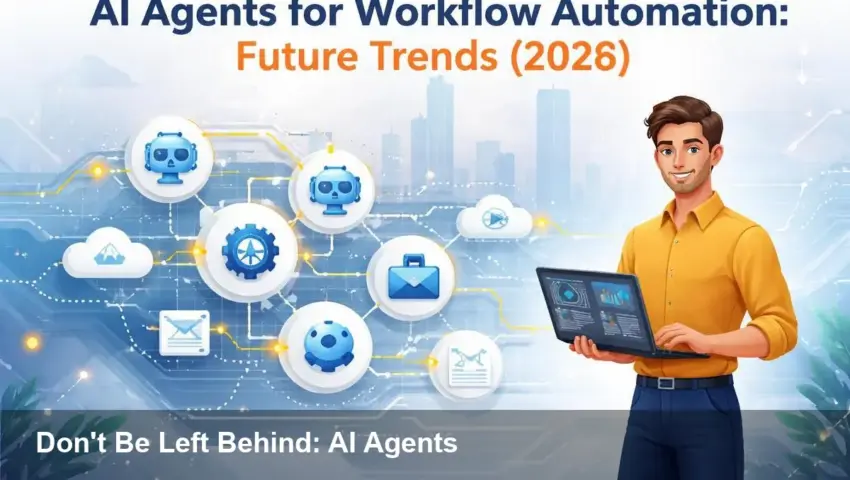
- AI agents are moving from experimental tools to practical workflow teammates in 2026.
- Early adopters report faster processes and reduced manual handoffs — but governance and error risk are rising.
- Key trends: autonomous task orchestration, low-code integrations, real-time decisioning, and stronger observability.
What’s changing in 2026
AI agents—task-oriented AI that can act, decide and coordinate across systems—are no longer just proofs of concept. In 2026 they’re being embedded into day-to-day workflows to handle repetitive tasks, suggest decisions and trigger downstream processes. The result: faster throughput, fewer manual handoffs and new expectations for speed and availability.
Major trends to watch
- Autonomous orchestration: Agents can now coordinate multi-step workflows across tools without constant human direction, tying together ticketing, billing, and communication systems.
- Low-code and no-code integration: Citizen developers can configure agent behaviors and connect services with minimal engineering support, accelerating adoption.
- Real-time decisioning: Agents increasingly make operational choices (prioritization, routing, simple approvals) and flag complex cases for humans.
- Observability and auditability: As agents take on more responsibility, teams are investing in logs, traceability and outcome monitoring to detect failures and bias.
Why this matters for organizations
Adopting AI agents can produce clear efficiency gains: shorter cycle times, lower error rates on routine tasks, and more consistent execution of repeatable work. There’s also powerful FOMO: teams that automate intelligently free staff for higher-value work and can respond faster to customers and partners.
But there’s a downside. Increased autonomy raises operational risk—misrouted work, hidden failures, and compliance gaps are real threats if governance is weak. That’s the negativity bias to heed: automation amplifies both gains and mistakes.
Practical applications
Customer support
Agents can triage tickets, suggest responses, and escalate only the complex issues to humans, shortening response times.
Finance and operations
Routine reconciliations, invoice processing and exception handling can be automated, with agents flagging anomalies for review.
Marketing and sales
Agents can assemble campaign data, suggest A/B tests, and trigger follow-ups based on customer signals.
How to adopt safely
Start with high-impact, low-risk processes: choose workflows where outcomes are measurable and reversibility is simple. Build clear observability—logs, dashboards, and human approval gates for exceptions. Involve legal, compliance and frontline users early to define acceptable behavior and escalation paths.
Bottom line
AI agents are becoming a mainstream tool for workflow automation in 2026. Companies that move thoughtfully—balancing aggressive adoption with governance and monitoring—stand to gain productivity and speed. Those that ignore the shift risk falling behind or facing costly errors as agent-driven processes scale.
Image Referance: https://vocal.media/journal/ai-agents-for-workflow-automation-future-trends-2026