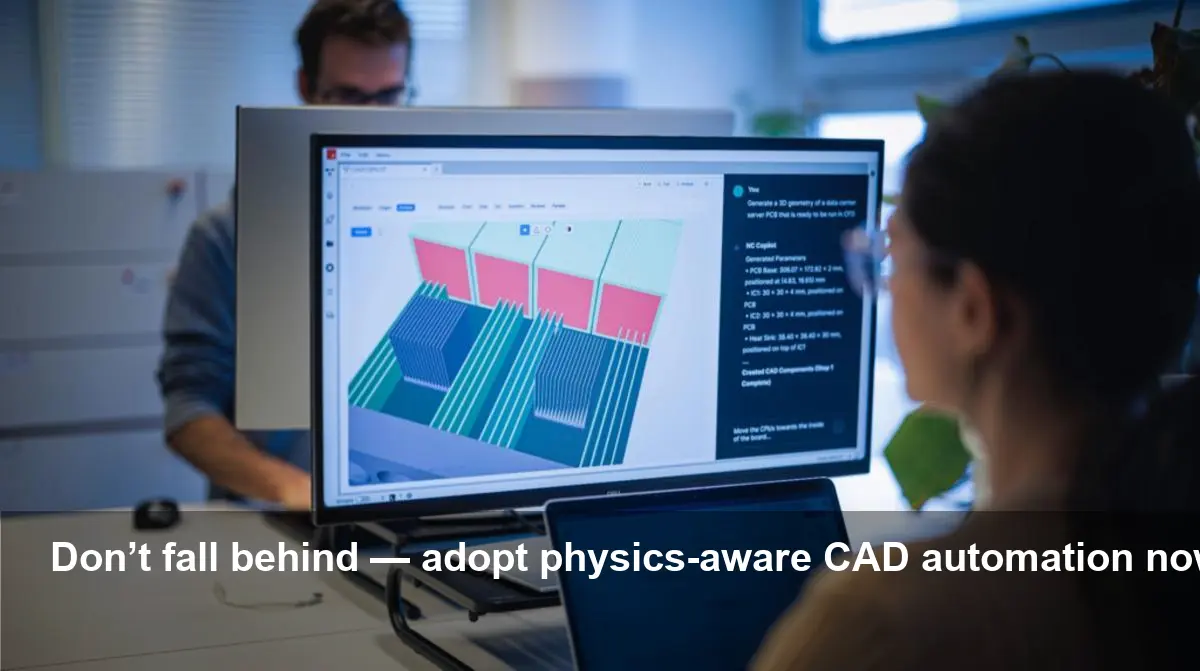
- AI Design Copilot introduces physics-aware, CAD-ready automation that connects simulation and CAD workflows.
- The tool automatically generates and validates geometry with built-in physics checks, cutting engineer iteration time.
- Supports export to common CAD formats and integrates with existing CAE pipelines to accelerate simulation-driven design.
- Early reports say teams see faster concept-to-validation cycles and fewer design rework loops.
AI Design Copilot: Physics-Aware Automation for Engineers
AI Design Copilot has launched a new set of capabilities that bring physics-aware automation directly into CAD-ready outputs, aiming to bridge the long-standing gap between generative design, simulation, and manufacturing-ready geometry. The feature set targets engineering teams that need faster iteration, reliable validation, and smoother handoffs between CAE and CAD tools.
Key features and how they help
Physics-aware generation
The Copilot’s core innovation is embedding physics constraints and simulation insight into the design-generation process. Instead of producing geometry that later fails simulation checks, the system proposes shapes that already respect structural, thermal or fluid dynamics constraints, reducing costly back-and-forth.
CAD-ready outputs
Generated parts and assemblies are exported in CAD-ready formats, with topology-to-B-rep conversions, clean feature histories, and tolerance-aware geometry. This avoids the common pitfall where AI proposals are unusable without significant manual fixing.
Seamless CAE integration
AI Design Copilot plugs into existing CAE workflows, allowing engineers to run quick physics checks, optimization loops, and sensitivity studies without leaving the design environment. The automation supports common solver inputs and can produce models that are ready for downstream meshing and analysis.
Impact on engineering workflows
By combining automation with physics validation, teams can reduce design iteration cycles and rework. The Copilot is positioned not as a replacement for engineering judgment, but as an assistant that surfaces validated design alternatives faster and highlights potential failure modes early.
Faster concept-to-manufacturing timelines
With CAD-ready exports and fewer simulation failures, organizations can move from concept to prototype-ready geometry more quickly, accelerating product development and lowering time-to-market risk.
Industry response and next steps
Early adopters report measurable reductions in iteration counts and improved confidence in first-pass validation. Vendors of downstream CAD and PLM systems are expected to expand integrations as demand grows. Engineers should evaluate pilot projects to quantify gains in their specific domains—structural, thermal, or fluid systems.
Conclusion
AI Design Copilot’s physics-aware, CAD-ready automation is a practical step toward more tightly coupled design and simulation workflows. For teams struggling with long iteration loops and late-stage simulation failures, adopting such tools can deliver immediate efficiency gains—and those who delay risk falling behind as peers embrace faster, validated design automation.
Image Referance: https://www.automotivetestingtechnologyinternational.com/news/cae-simulation-modeling/ai-design-copilot-introduces-physics-aware-cad-ready-automation-for-engineers.html