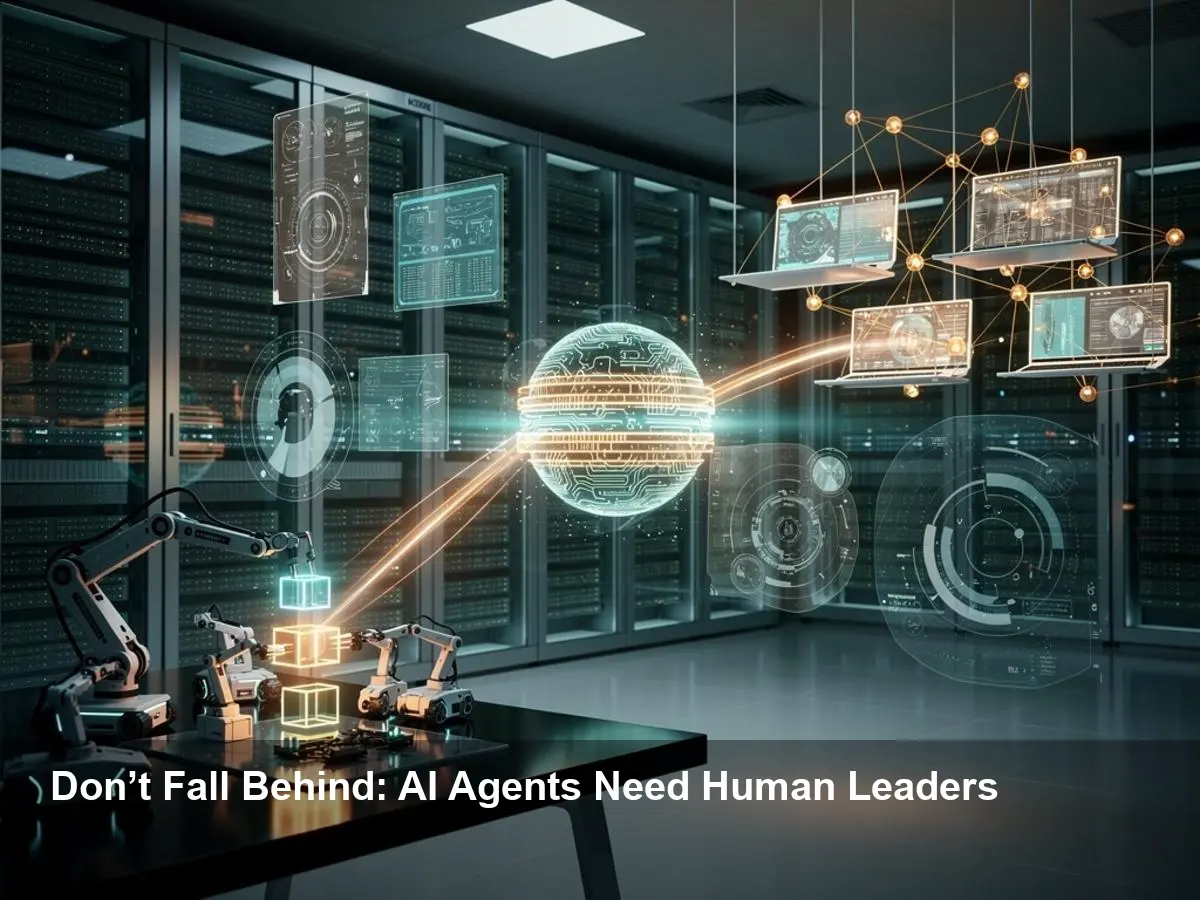
- AI agents are rapidly automating repetitive and decision-rules work, shifting human roles toward coordination and strategy.
- Companies report gains in speed and consistency, but experts warn of oversight, alignment, and accountability gaps.
- Human coordinators become the critical link — managing agent teams, validating outputs, and handling exceptions.
- Adopting the right governance, tooling, and training is now a competitive necessity — delay risks falling behind.
AI Revolutionizes Work: Automating Agents, Empowering Human Coordinators
The rise of autonomous AI agents is changing how work gets done. Rather than simply automating single tasks, modern agents — software processes that can plan, act, and iterate — are taking on multi-step workflows. That’s freeing people from repetitive execution, but it’s also creating a new, high-stakes role: the human coordinator who supervises collections of agents, resolves edge cases, and ensures outputs meet organizational goals.
What’s actually changing?
Where previous generations of automation replaced narrowly defined tasks, agent-based systems can chain actions, retrieve context, and adapt mid-workflow. The result: faster throughput, more consistent execution, and the ability to scale processes previously limited by human availability. But automation at this scale exposes gaps in judgment, ethics, and error handling that only humans can reliably address today.
The role of the human coordinator
Human coordinators act as the architects and governors of agent fleets. Their responsibilities include:
- Designing agent workflows and escalation rules.
- Validating outputs and correcting drift or bias.
- Managing exceptions, ambiguous cases, and stakeholder communications.
- Setting metrics and continuous improvement cycles for agent behavior.
Early results and social proof
Organizations that pair autonomous agents with skilled coordinators report faster cycle times and improved employee satisfaction, according to industry reporting and pilot programs. Teams say agents handle routine throughput, while humans focus on high-value decisions, creative problem solving, and cross-team alignment.
Risks and reasons to act now
Neglecting governance invites problems: incorrect actions at scale, amplified biases, and compliance failures. The fear of missing out (FOMO) is real — lagging companies risk productivity loss and being outmaneuvered by competitors that establish agent governance early. Equally, rushing adoption without training and monitoring creates its own liabilities.
Practical steps for leaders
- Start small: pilot agent workflows in low-risk areas to learn and iterate.
- Define clear escalation paths and human-in-the-loop checkpoints.
- Invest in coordinator training — not just technical skills but judgment, ethics, and communication.
- Implement monitoring, logging, and audit trails to maintain accountability.
Bottom line
AI agents are not a straight replacement for human work; they reshape roles. Success depends on empowering people to lead, govern, and refine agent behavior. Organizations that balance automation speed with robust human coordination will capture the benefits while avoiding costly mistakes — and those that delay risk losing ground.
Image Referance: https://www.webpronews.com/ai-revolutionizes-work-automating-agents-empowering-human-coordinators/