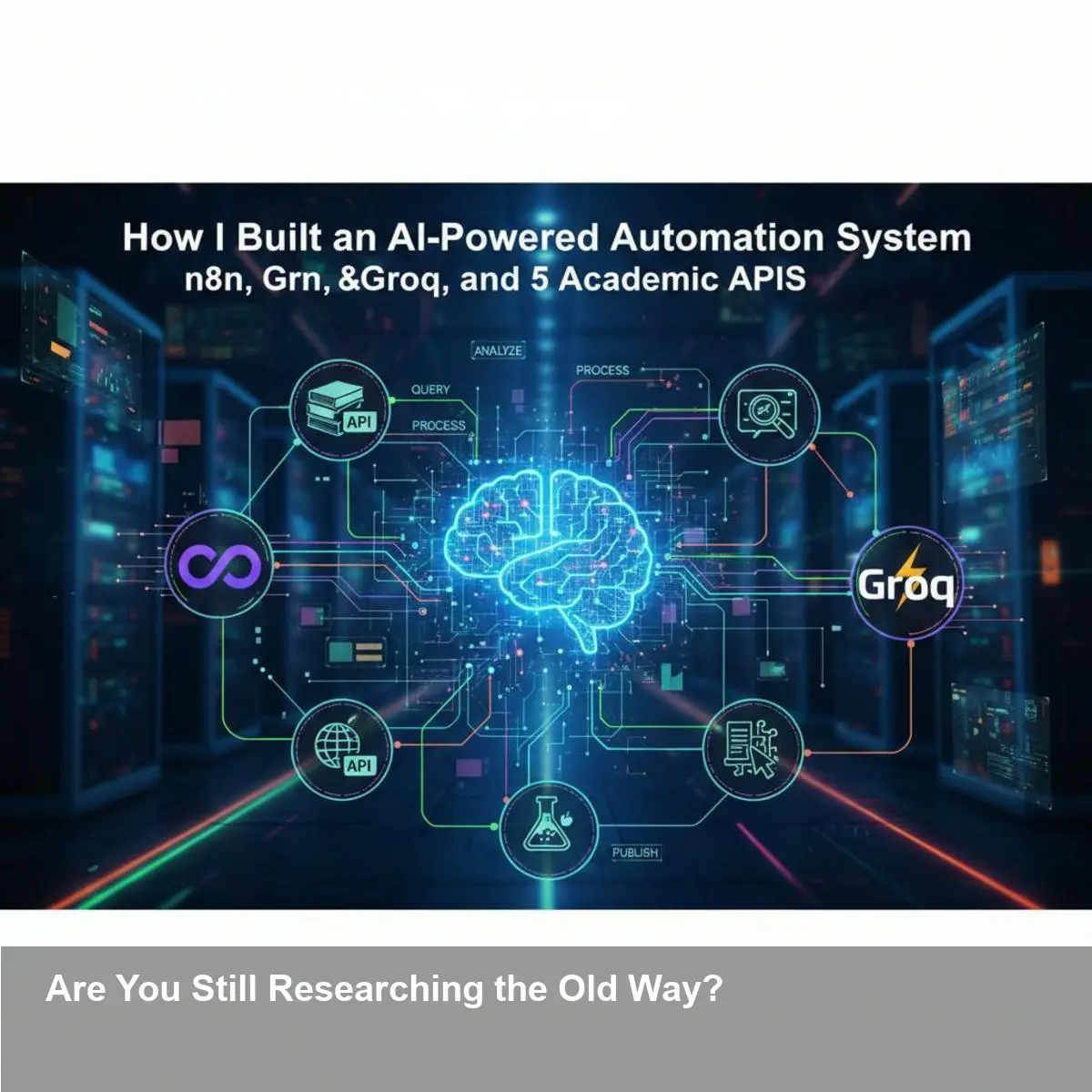
- Discover how a powerful research automation system can be built using the low-code platform n8n.
- The system integrates five major academic APIs: Semantic Scholar, arXiv, CORE, Springer, and CrossRef to gather comprehensive data.
- It leverages Groq’s ultra-fast LPU™ inference engine with the Llama 3 model to analyze and summarize findings in seconds.
- This workflow transforms a tedious, multi-hour research process into an efficient, automated task that yields superior results.
The End of Tedious Manual Research
The days of spending countless hours sifting through academic papers and manually compiling research notes may be over. A groundbreaking new approach demonstrates how to build a powerful AI-powered research assistant using accessible low-code tools, effectively turning a week’s worth of work into a matter of minutes. This automated system not only saves time but also enhances the quality of research by systematically analyzing a vast array of sources.
The Core Components of the AI Research Assistant
This innovative solution is built on three key pillars: a powerful automation platform, a comprehensive data collection network, and a lightning-fast AI analysis engine. By combining these elements, the system creates a seamless workflow from initial query to final summarized report.
n8n: The Automation Backbone
At the heart of the system is n8n, an open-source, low-code workflow automation tool. n8n acts as the central orchestrator, connecting the various services and managing the flow of data. Its visual, node-based interface allows users to build complex workflows without writing extensive code, making this powerful technology accessible even to those without a deep programming background.
The 5 Academic APIs: Casting a Wide Net
To ensure the research is thorough, the system queries five of the largest academic databases simultaneously via their APIs:
- Semantic Scholar: For AI-powered paper discovery.
- arXiv: For access to pre-print articles in STEM fields.
- CORE: For aggregating open-access research from repositories worldwide.
- Springer Nature: For a vast collection of scientific documents.
- CrossRef: For metadata on millions of academic items.
This multi-API approach ensures a wide and diverse range of sources are included in the analysis, preventing informational blind spots.
Groq and Llama 3: The Engine of Insight
Once the data is collected, it’s fed to the GroqCloud API, which runs the Llama 3 language model on its proprietary LPU™ inference engine. The standout feature here is speed. Groq’s hardware is designed for unparalleled performance in AI inference, allowing it to process and analyze the aggregated research data almost instantly. The AI is prompted to act as an expert research assistant, tasked with synthesizing the information into a coherent and insightful summary.
How the Automated Workflow Operates
The process is elegantly simple yet incredibly powerful:
- Initial Query: The workflow is triggered with a single research topic or question.
- Concurrent Fetching: n8n sends out simultaneous requests to all five academic APIs.
- Data Consolidation: The results are collected, merged, and de-duplicated to create a clean, unified dataset.
- AI Analysis: The cleaned data (titles, abstracts, authors) is passed to the Groq node. The Llama 3 model then performs a comprehensive analysis, identifying key themes, novel methodologies, research gaps, and a consolidated summary.
- Final Output: The system outputs a detailed, AI-generated research brief, ready for review.
Why This Changes Everything for Researchers
This automated system represents a paradigm shift for students, academics, and professionals in any research-intensive field. It eliminates the most time-consuming and monotonous aspects of the research process, freeing up valuable time for critical thinking, experimentation, and analysis. By leveraging the speed of Groq and the orchestration power of n8n, anyone can now build a personalized research assistant that delivers comprehensive, lightning-fast results, ensuring they don’t get left behind in a world of rapidly advancing information.
Image Referance: https://hackernoon.com/how-i-built-an-ai-powered-research-automation-system-with-n8n-groq-and-5-academic-apis