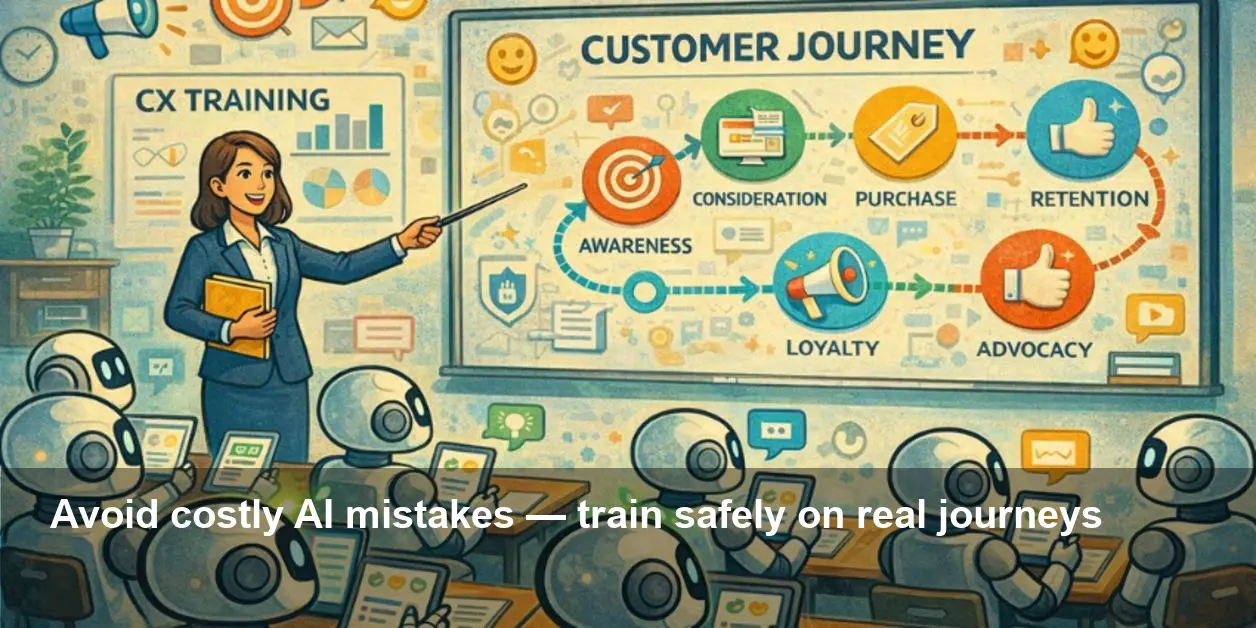
- Real customer journeys are the best route to useful AI agents — but training on them brings privacy, bias and compliance risks.
- Follow a privacy-first pipeline: anonymize, synthesize, and use human-in-the-loop validation to keep models accurate and safe.
- Implement monitoring, cohort testing and strict guardrails to catch regressions and edge-case failures before they hit customers.
- Start small, measure impact on real metrics (NPS, resolution time) and scale when results match business and compliance standards.
Why train AI agents on real customer journeys?
Real customer journeys encode the timing, intent and friction points your customers actually experience. Training AI agents on these sequences — from search or ad click through purchase and support — makes virtual assistants and automations far more accurate and context-aware. Teams that skip journey-based training risk brittle models that hallucinate, misroute queries or degrade CX.
Primary risks to mitigate
- Data privacy and compliance: personal identifiers and sensitive content in logs can violate GDPR, CCPA and internal policies.
- Bias and representativeness: historical journeys can over-represent some segments and under-represent others, producing unfair or useless agents.
- Security and IP leakage: conversation logs sometimes reveal secrets or contract terms that shouldn’t be exposed.
- Operational risk: poorly validated agents escalate issues, increasing deflection failure and customer frustration.
Safe training checklist
- Scope and mapping: define which journeys (e.g., onboarding, billing, returns) the agent must master and map typical conversation flows.
- Privacy-first data handling: remove direct identifiers, tokenise or hash IDs, and apply differential privacy or k-anonymity where appropriate.
- Synthetic augmentation: where data is sparse or sensitive, generate synthetic journeys that preserve behavior patterns but not real PII.
- Human-in-the-loop (HITL): use agents to draft answers but keep humans for validation, especially for high-risk intents like refunds or legal queries.
- Bias audits: measure performance across cohorts (age, region, language) and rebalance training data to avoid systematic failures.
- Guardrails & intent thresholds: set confidence cutoffs, fallback flows and escalation paths to live agents.
Measuring success and monitoring
Deploy with phased experiments: A/B test agent-assisted conversations against baseline, tracking resolution time, escalation rate, CSAT/NPS and error incidence. Set automated alerts for spikes in low-confidence responses or sentiment drops. Keep an audit log for training data provenance and model changes to support compliance reviews.
Operational tips and next steps
Start with a single high-value use case, instrument it well, and iterate weekly. Involve compliance, security and frontline staff in both design and review loops. As models prove safe and effective, expand to other journeys while retaining strict monitoring and retraining cadences.
Training AI agents on real customer journeys can transform service and conversion — but only if done with privacy, bias controls and operational guardrails. Follow the checklist, measure impact, and scale cautiously to avoid costly customer-facing failures.
Image Referance: https://www.cxtoday.com/marketing-sales-technology/ai-agent-training-on-customer-journeys/