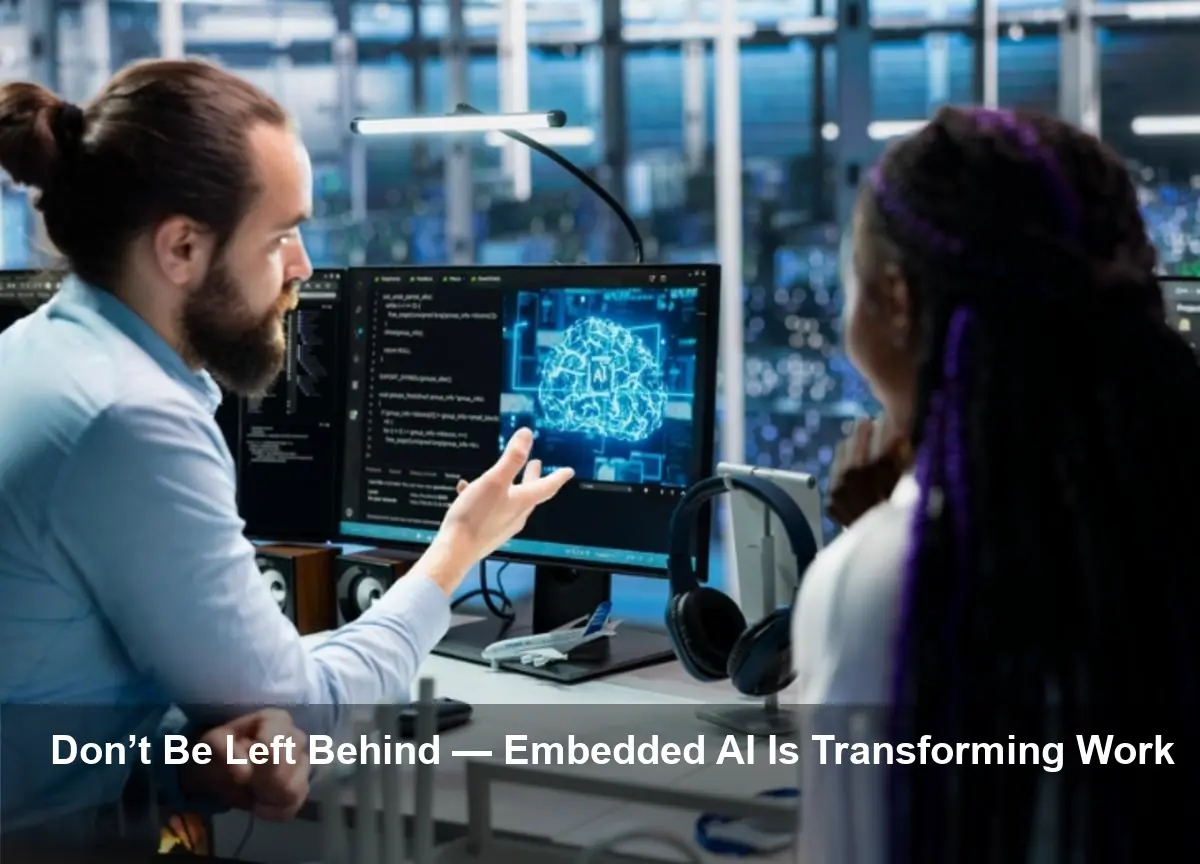
- Embedded AI augments human teams across finance, HR, customer service and operations, reducing repetitive work and errors.
- Integrated models provide context-aware suggestions while preserving data security and regulatory controls.
- Companies that delay adoption expose themselves to higher costs, slower decisions and competitive disadvantage.
Embedded AI That Works With People: How Enterprises Are Simplifying Work
What “embedded AI” really means
Embedded AI refers to machine-learning models and automation capabilities built directly into business applications and workflows rather than delivered as separate tools. Rather than replacing people, these systems nudge, augment and accelerate human decision-making — suggesting next best actions, auto-filling forms, flagging anomalies and routing work to the right teams.
Where embedded AI is already making a practical difference
Across industries, embedded AI is applied to:
- Business process automation: streamlining invoice processing, contract review and HR onboarding to cut manual steps and cycle time.
- Customer operations: giving agents context and suggested replies, reducing average handle time and improving satisfaction.
- Risk management and compliance: continuously scanning transactions and documents for suspicious patterns while keeping audit trails.
- Data security: enhancing anomaly detection, access monitoring and policy enforcement without blocking legitimate workflows.
Real benefits — and real urgency
Enterprises report faster decision cycles, fewer human errors and measurable cost savings when embedded AI is thoughtfully integrated. But there’s a downside: organizations that postpone pilots face higher operating costs and slower responsiveness as competitors adopt AI-enabled practices. That negative outcome — falling behind — is a key reason many leaders are prioritizing pilots now.
Human-centric design and governance
Successful embedded AI emphasizes explainability, user control and clear escalation paths. Systems should surface confidence scores, allow employees to override suggestions, and log decisions for auditing. Governance frameworks that combine technical controls, role-based access and periodic model reviews reduce the risk of bias, drift and regulatory exposure.
Implementation tips for leaders
Start with high-impact, low-risk processes: repetitive tasks with clear outcomes. Use low-code platforms or APIs to integrate models into existing tools, run short pilots, measure outcomes (time saved, error reduction, compliance metrics) and iterate. Prioritize data privacy: keep sensitive processing on-premises or in private clouds when required, and maintain strong encryption and identity controls.
Why you can’t wait
Embedded AI isn’t a speculative technology — it’s already reshaping workflows in many enterprises. Delaying adoption risks lost efficiency, higher manual workload, and competitive disadvantage. By starting small with strong governance, organizations can capture upside while controlling risk — turning AI from a threat into a practical partner for daily work.
Image Referance: https://readitquik.com/ai/ai-that-works-with-people-how-embedded-ai-systems-are-simplifying-enterprise-work/