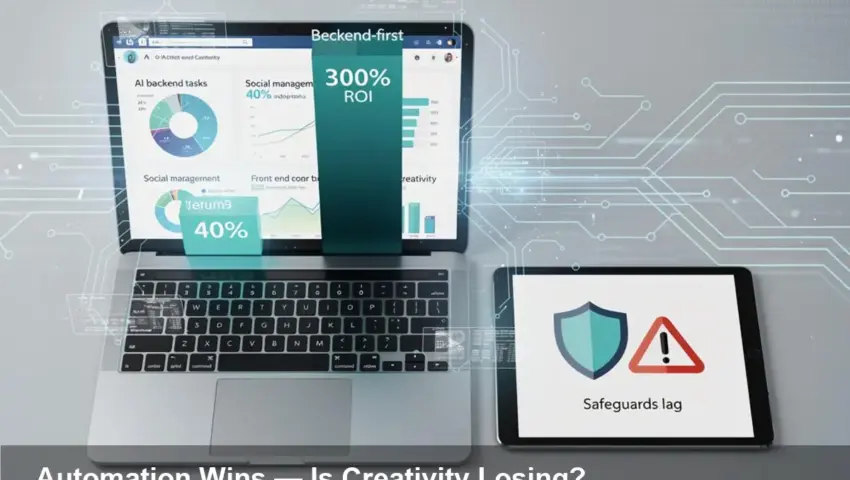
- Many marketing teams are prioritizing AI automation over creative development.
- Backend AI improves speed, scale and measurability, but can hollow out original ideas.
- The shift raises risks for brand differentiation, team skills and long-term customer trust.
- Marketers must balance automation gains with deliberate investment in creativity and measurement.
Why automation is surging in marketing
Over the past few years, AI tools that operate behind the scenes—optimizing ad buys, auto-generating copy variations, personalizing email sends, and streamlining workflows—have gone from niche to mission-critical. These backend systems promise faster turnarounds, consistent performance, and clear metrics. For teams under pressure to hit KPIs, automation is an easy answer: it reduces repetitive work, scales personalization, and produces measurable lifts that leaders can report up the chain.
What marketers gain — and what they risk losing
Automation delivers clear benefits: speed, volume, and predictability. Many teams report being able to run more campaigns with fewer manual steps and better attribution. That creates strong social proof inside organizations: when automation delivers reliable wins, more stakeholders push for its use.
But there’s a downside: deprioritizing creativity can erode brand distinctiveness. Creative ideas, brand storytelling and nuanced emotional work are harder to quantify and slower to prove. Over-reliance on backend AI can lead to homogenous messaging, short-term lifts at the expense of long-term loyalty, and a skills gap as in-house creative capacity atrophies. Those are real risks that often only become visible after brand fatigue or declining engagement.
Why teams favor automation over creative investment
Three practical forces drive the shift. First, measurable outcomes: automation produces clear, reportable metrics that win budget and attention. Second, resource pressure: with tight timelines and smaller teams, automation reduces labor. Third, FOMO—when competitors automate and gain efficiency, others feel compelled to follow quickly to avoid falling behind.
How to restore balance: practical steps for teams
Automation and creativity don’t have to be opponents. Successful teams treat automation as an efficiency engine and creativity as the strategic differentiator. Practical approaches include:
- Ring-fencing budget and time for original creative work rather than cutting it when under pressure.
- Using automation to test and scale creative winners, not replace the creative process itself.
- Measuring brand health and long-term engagement, not only short-term conversion metrics.
- Training teams so staff retain creative skills while learning to operate automation tools.
Why this matters
At its best, backend AI frees talent from repetitive tasks so humans can focus on strategic, creative work. At its worst, it turns marketing into a library of optimized but indistinguishable outputs. Marketers who recognize both sides of the trade-off—and deliberately protect creative investment—are likelier to deliver sustainable growth and memorable brands.
Image Referance: https://www.webpronews.com/ais-backend-blitz-why-marketers-prioritize-automation-over-creativity/