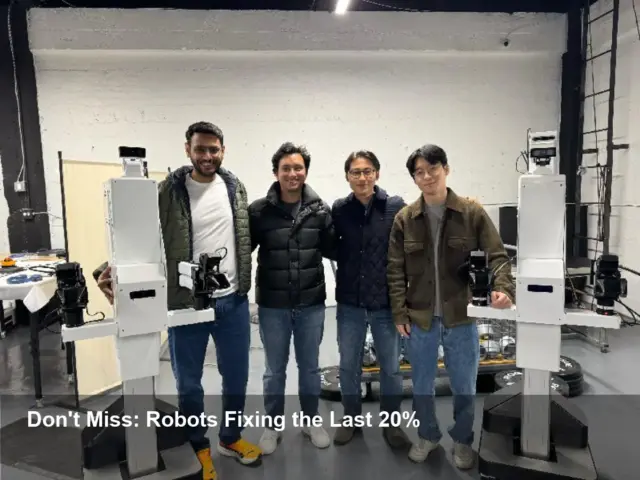
- San Francisco-based Deft Robotics has closed an undisclosed seed funding round.
- Investors include Rainfall Ventures and Korean VC firm SpringCamp.
- The startup aims to use AI-powered humanoid robots to address manufacturing’s so-called “last 20%” of work.
What happened
San Francisco startup Deft Robotics announced it has secured an undisclosed seed funding round led by Rainfall Ventures and including Korean venture firm SpringCamp. The company says it will use the capital to develop AI-powered humanoid robots focused on the persistent, difficult-to-automate portion of factory work often described as the “last 20%.”
Why this matters
Manufacturers have automated predictable, repetitive tasks for years, yet many lines still rely on human hands for complex, variable operations — the so-called “last 20%” that resists standard automation. Deft Robotics is positioning humanoid, AI-driven machines to fill that gap, promising flexibility across diverse tasks without retooling entire production lines.
The involvement of Rainfall Ventures and SpringCamp provides early social proof: investors see potential in combining advanced AI and humanoid form factors to tackle real-world manufacturing bottlenecks. While the funding amount was not disclosed, seed-stage backing from known investors signals confidence and could accelerate product development and early pilots.
Challenges and limitations
Humanoid robots face substantial technical and commercial hurdles. The “last 20%” often requires fine motor skills, perception in unstructured environments, and quick adaptation to part variation — areas where robots still lag behind humans. Beyond engineering, adoption challenges include safety certification, integration with existing systems, workforce training, and cost-effectiveness for manufacturers operating on thin margins.
Deft Robotics’ announcement is promising but not definitive: seed funding is typically aimed at proving feasibility, building prototypes, and securing pilot customers. There is no public timetable yet for commercial deployment or details about the robot’s capabilities, price point, or target industries.
Industry context
Interest in humanoid and generalist robots has risen as companies look for more flexible automation that can handle varied tasks across industries. Deft joins a growing field of startups and research efforts trying to move beyond task-specific robotic arms toward machines that can operate in human-centric spaces.
That trend reflects a broader shift in automation strategy: rather than replacing high-volume, predictable tasks, the next wave aims to address remaining, lower-volume but high-value work that still depends on human dexterity. If successful, this could improve throughput, reduce error rates, and enable factories to reshuffle labor toward oversight and higher-skill roles.
What to watch next
Key signs to monitor in the coming months include product demonstrations, pilot agreements with manufacturers, details about the robots’ sensing and manipulation abilities, and any partnerships that streamline integration into existing production lines. Watch also for information on commercialization timelines and whether Deft can show clear ROI for early adopters.
For now, Deft Robotics’ seed round marks an early but notable step: investors are betting that AI-powered humanoid robots might finally chip away at the stubborn “last 20%” of manufacturing work.
Image Referance: https://en.wowtale.net/2026/02/08/233492/