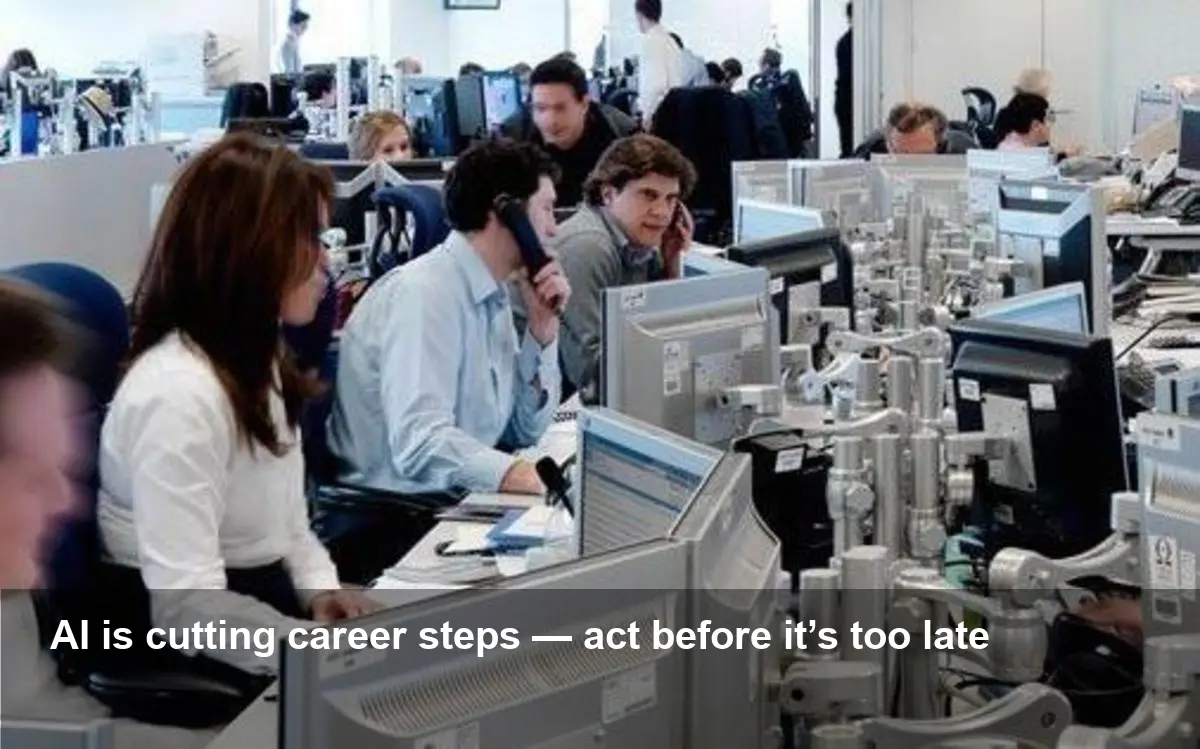
- AI is automating routine and mid-skilled tasks, shrinking traditional promotion paths.
- Junior employees face fewer stepped-up roles; managers must redesign career ladders.
- Companies that fail to reskill risk talent flight and a fractured workforce.
AI Is Hollowing the Talent Ladder — What’s Happening
Artificial intelligence is accelerating automation across industries, not just replacing individual tasks but changing the structure of careers. Rather than removing only frontline work, AI is increasingly capable of handling many mid-level, repeatable functions that previously formed the ladder between entry-level jobs and senior roles. The result: fewer intermediate positions, narrower promotion pathways and a rising risk of career stagnation for large cohorts of employees.
Why the middle is shrinking
AI excels at pattern recognition, process optimisation and decision support — capabilities that map well to many mid-career duties such as data processing, routine analysis, scheduling, compliance checks and first-line supervision. As organisations adopt AI tools to drive efficiency and reduce costs, these functions are often consolidated into automated systems or redefined into smaller, more technical jobs. That consolidation removes the stepping-stone roles younger staff relied on to learn, prove themselves and advance.
Short-term gains, long-term risks
Deploying AI can deliver measurable short-term gains: faster throughput, lower error rates and cost savings. But the hollowing of the talent ladder carries long-term risks. With fewer intermediate roles, companies lose built-in development channels that groom future leaders. Employees who would normally progress through a sequence of increasingly responsible roles may find themselves stuck, leaving employers with retention issues, a weakened leadership pipeline and a less diverse pool of senior talent.
Who wins — and who loses
Senior strategic and creative roles that require complex judgement, relationship management and cross-functional leadership remain harder to automate and may grow in value. Technical specialists who build and maintain AI systems also gain. But many mid-career professionals whose work is repeatable, measurable and rule-based face the greatest risk — a change that could widen income and skills gaps across organisations and industries.
What organisations and workers should do
Both employers and employees must act deliberately to prevent damage to career mobility. Practical steps include:
- Redesigning career ladders to include hybrid roles that mix human judgement with AI oversight.
- Investing in continuous reskilling and structured on-the-job learning focused on higher-order skills: leadership, complex problem solving, stakeholder management and AI literacy.
- Creating internal rotational programmes and mentorship paths that give employees exposure to strategic work earlier.
- Measuring the impact of AI on internal mobility and publishing transparency reports to retain trust.
Conclusion
AI’s promise of productivity is real, but without intentional workforce design it can hollow out the very pipelines organisations need to renew leadership and maintain an engaged workforce. Companies that proactively redesign roles and invest in people will secure a competitive advantage — those that don’t risk losing talent and seeing their talent ladders collapse.
Image Referance: https://splash247.com/ai-is-hollowing-out-the-talent-ladder/