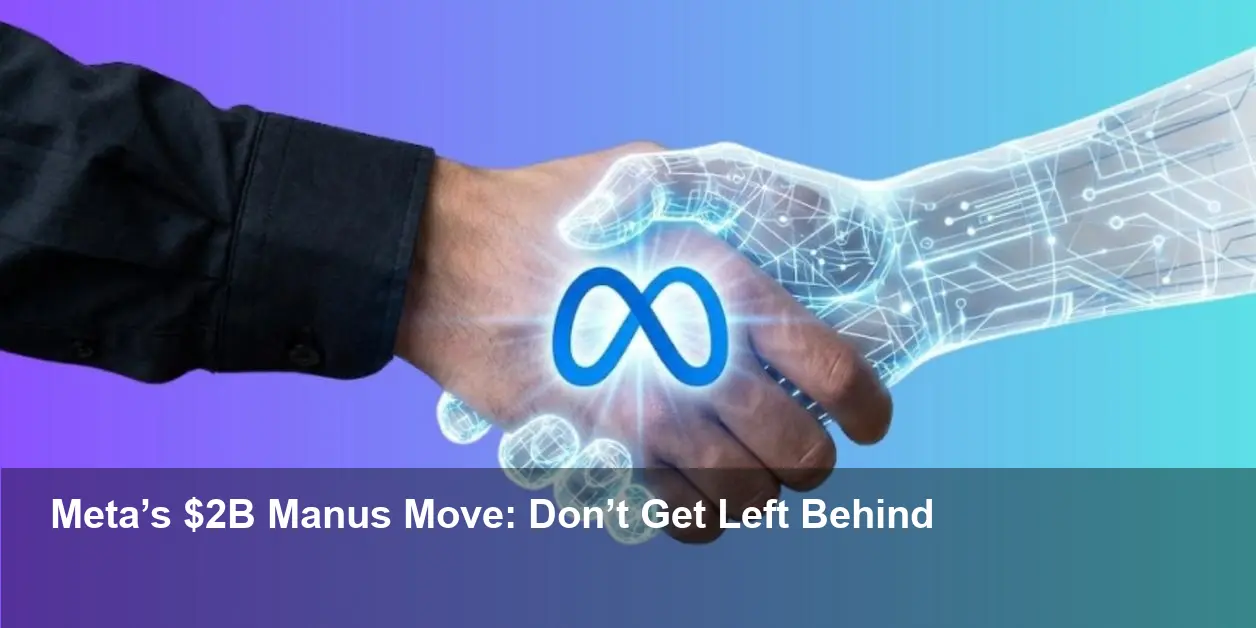
Meta Buys the “Hands” for its AI Brain — What the $2B Deal Means
- Meta has acquired Manus AI for approximately $2 billion, marking a strategic move beyond chatbots into autonomous agents and embodied AI.
- The purchase signals new customer experience (CX) use cases, with likely integrations across WhatsApp and Meta’s broader ecosystem.
- Industry watchers say the deal accelerates Meta’s bid to outflank OpenAI and other rivals in agent-driven automation — raising competition, privacy and regulatory questions.
Why Meta bought Manus
Meta’s acquisition of Manus AI — a company known for advanced hand-tracking, haptic and embodied-control technologies — is being framed internally as buying the “hands” for an increasingly capable AI brain. The move signals a shift in focus from purely conversational chatbots toward autonomous agents that can interact in richer, more physical or virtual ways.
From chat to action
Chat-based models excel at text and dialogue, but they remain limited when tasked with simulated or real-world manipulation, gesture control, or immersive interfaces. Manus technology fills that gap, enabling agents to perceive and act through precise hand and motion control. For Meta, this can mean more natural, intuitive user experiences across augmented reality (AR), virtual reality (VR), and messaging platforms like WhatsApp.
Customer experience implications
For CX teams, the acquisition opens new possibilities: automated agents that not only answer questions but can guide users through interactive tutorials, remotely manipulate digital interfaces, or operate virtual product demos with realistic hand motions. That could reduce friction and call volumes — but it also shifts the balance of power in customer interactions toward automated systems that may replace human agents.
Strategic impact: OpenAI, competition and timing
Observers view the Manus purchase as part of a broader competition between Meta and leading AI players such as OpenAI. By integrating embodied control into its agent strategy, Meta may leap ahead in offering agents capable of more autonomous, multimodal tasks — from coordinating services to controlling virtual or IoT devices through gesture-driven interfaces.
Risks and scrutiny
As Meta accelerates agent capabilities, privacy, security and regulatory scrutiny will intensify. Embodied agents that can act on behalf of users — potentially across messaging, devices and AR/VR environments — create new vectors for misuse, deepfake-style manipulation, or unauthorized actions. CX leaders and regulators will need to weigh convenience against safeguards and transparency.
What to watch next
Expect rapid product-level experimentation inside Meta: tighter WhatsApp integrations, new AR/VR demos using Manus tech, and pilot deployments in customer support. For enterprises and CX professionals, now is the time to reassess automation strategies and governance, preparing for agents that do more than talk — they act.
While the full terms and product road map remain under wraps, Meta’s $2B Manus buy is a clear signal: the next phase of AI will be less about text and more about embodied, autonomous agency — and the winners will be those who balance capability with trust.
Image Referance: https://www.cxtoday.com/ai-automation-in-cx/meta-buys-the-hands-for-its-ai-brain/