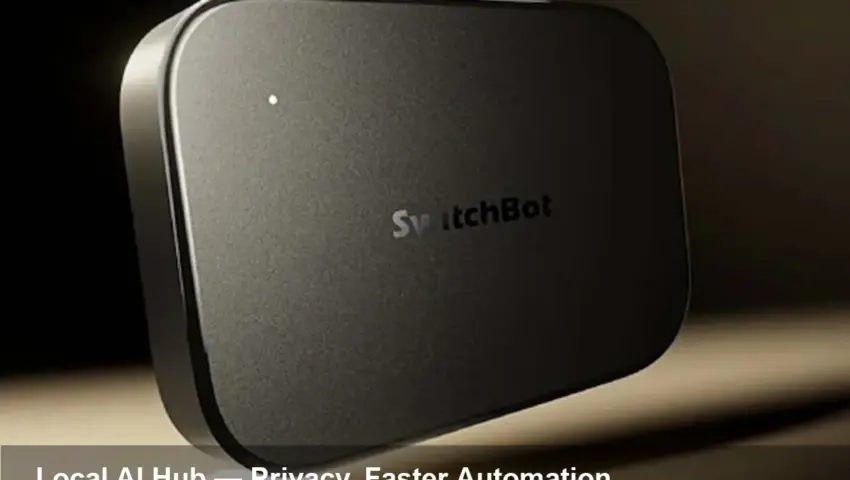
- SwitchBot is offering a new smart home hub that runs AI locally rather than relying on the cloud.
- The hub is intended to enable faster, more complex automations and better privacy protections.
- This approach could appeal to privacy-conscious and advanced users who want on-device control.
- Potential trade-offs may include added setup complexity and limits compared with cloud services.
What SwitchBot is announcing
SwitchBot is now offering a smart home hub built around local AI processing. Unlike cloud‑dependent systems, the hub is intended to run AI tasks on the device itself, enabling quick responses and more sophisticated automations without sending data to remote servers. According to the product description, the move toward on‑device intelligence aims to open up new use cases while improving privacy.
Why local AI matters for smart homes
Local AI changes two core dynamics in home automation: latency and data control. Processing decisions on the hub can reduce lag for time‑sensitive actions (for example, triggering devices based on voice or sensor input) because commands don’t need to travel to the cloud and back. It also keeps more user data inside the home network, a strong selling point for people worried about surveillance or third‑party data retention.
Beyond privacy and speed, on‑device intelligence can enable more complex automation logic to run continuously without relying on an internet connection. That means automations that combine multiple inputs or run advanced decision trees could become practical for everyday users and hobbyists alike.
Who benefits — and who should be cautious
Privacy‑conscious users and power users who enjoy building multi‑step or conditional automations are the most obvious beneficiaries. Because the hub focuses on local processing, it should appeal to anyone who prefers their home automation to operate independently of cloud services.
However, running AI locally can introduce trade‑offs. Advanced functionality may require more hands‑on setup, and some convenience features that depend on cloud services (cross‑region voice assistants, remote cloud routines, or large‑scale machine learning models) might not be available or may function differently. Users should weigh the privacy and speed gains against possible limitations in remote access, updates, or integrations that traditionally rely on cloud back‑ends.
Why this could matter for the market
SwitchBot’s move reflects a wider interest in edge computing for consumer devices. As smart home ecosystems mature, manufacturers and users are looking for ways to make automations more reliable and private. Local AI hubs could nudge competitors to offer similar options, especially for buyers who prioritize data control and low latency.
What to watch next
Key follow‑ups will include details on supported devices and platforms, how SwitchBot implements updates and model improvements, and whether integrations with popular smart home ecosystems are preserved. Also important will be the ease of configuration for less technical users — if local AI proves complicated to set up, its audience could be limited to enthusiasts.
For now, the announcement positions SwitchBot as an early adopter of local AI in the smart home space, promising faster, more complex automations and stronger privacy — with the usual trade‑offs between control and convenience.
Image Referance: https://www.notebookcheck.net/SwitchBot-AI-Hub-offers-local-AI-power-for-fast-and-complex-smart-home-automation.1207729.0.html