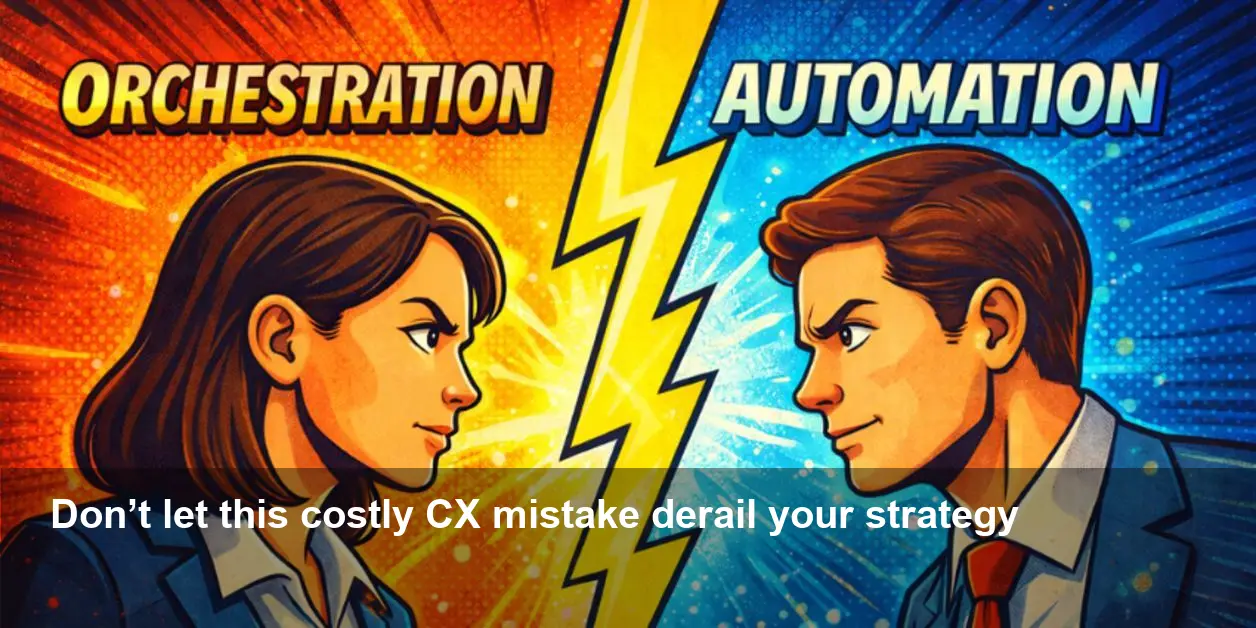
- Most CX leaders discover the limits of marketing automation only after scaling — costing agility and customer trust.
- Unified journey orchestration (UJO) focuses on real-time, cross-channel decisions; marketing automation (MA) centers on campaign-driven workflows.
- Choosing the wrong approach leads to fragmented experiences, wasted budget and missed personalization at scale.
- Practical steps: map journeys, audit data flows, pilot orchestration where real-time decisions matter.
Unified Journey Orchestration vs Marketing Automation: The Difference Most CX Leaders Learn Too Late
As companies race to create seamless customer experiences, two terms are often confused: unified journey orchestration (UJO) and marketing automation (MA). They overlap, but their purpose, architecture and impact on CX are distinct. Confusing them can leave teams with brittle systems, inconsistent experiences and wasted investment.
What marketing automation actually does
Marketing automation is campaign-centric: it automates email, lead nurturing, scoring and scheduled communications based on predefined triggers. It’s excellent for scaling repetitive campaigns, standardizing outreach and managing marketing pipelines. But it typically operates in batch or near-batch modes and is designed around marketing use cases rather than holistic customer context.
What unified journey orchestration adds
Unified journey orchestration sits above channels and systems to make real-time, contextual decisions across the whole customer lifecycle. UJO ingests signals from multiple systems (product, CRM, support, analytics), evaluates customer state, and chooses the best next action — on any channel — to progress the journey. It’s event-driven, often real-time, and built to handle complex, non-linear journeys.
Key differences at a glance
- Scope: MA = campaign-level; UJO = journey-level across systems.
- Timing: MA = scheduled/batch; UJO = real-time/event-driven.
- Decisioning: MA = rule/trigger-based; UJO = centralized decision engine often using advanced logic or ML.
- Data: MA = limited to marketing data; UJO = consolidated signals from product, sales, service and more.
Why CX leaders often learn too late
Teams usually adopt marketing automation first because it delivers quick wins. As customer journeys grow more complex, the limitations become apparent: messages contradict across channels, opportunities for timely interventions are missed, and personalization plateaus. By the time leaders realize a broader orchestration layer is needed, they face integration debt and higher migration costs.
How to avoid the common pitfall
Start with clear goals: identify moments that demand real-time decisions (e.g., product abandonment, service escalations, proactive retention). Audit where your data lives and which systems must be integrated. Pilot UJO for the highest-impact journeys rather than attempting a full rip-and-replace. Maintain governance and measurement to prove value quickly.
Bottom line
Marketing automation remains vital for campaign scale. But to deliver resilient, personalized CX at scale, many organizations need a unified orchestration layer that thinks beyond campaigns and orchestrates the whole journey. CX leaders who recognize and act on this early protect customer experience, reduce waste and stay competitive — don’t wait until the problem is costly and entrenched.
Image Referance: https://www.cxtoday.com/marketing-sales-technology/journey-orchestration-vs-marketing-automation/